

Guest Post: Building a Bridge to Opportunity
What does it mean to be successful? Who am I and what am I here to do? What is my legacy?
I have asked myself and others these questions my entire life. But, when you grow up in the Lower East Side during the seventies and eighties, the answers are not so clear.
There were community bandaids like sports and girls, but without the right guidance and mentor, I fell into every trap society has built for Black and Brown men like me.
The more I fell, the harder it became for me to get up. At some point, it was just easier for me to stay on the floor. At least there, I didn’t have to worry about falling again.
I fell in love with “easy” so much, I began to invest in it—drugs, girls, party, gangs. Since I was heir to addiction and poverty, no one responsible for me expected any more of me. And, the cycle just continued.
Success to me was the accumulation of things that came easy. Legacy was a foreign word because the life expectancy of the men in my family was 30 and for men like us from our neighborhoods, we were lucky if we reached 40 without being 6 feet under or locked in a box for life.
What did I have to lose, right? And the cycle continued, the bridges burned, and the floor became more comfortable. The floor for me was often inside a cell. I was 16 the first time I went to Rikers and 47 the last time I was released from a state bid. In between were 76 arrests, 3 state bids and a federal bid. I have achieved every level of the criminal justice system.
As the cycle continued, every time I fell, I got back up slowly with questions about my identity and place on Earth. Then, I would become distracted and numb those questions away with a needle and a heroin addiction that lasted decades. Until the day came when I began to question who I was and what I was placed here to do.
My inquiry has taken me to question my history, my family’s legacy, my purpose, and all those around me. It took me to dark places. It forced me into confined spaces. And finally, it led me to question God. And there I made the most important discovery of my life. As the heir to addiction and poverty and as a Black man, we are meant to fall. Getting back up successfully means choosing the path of most resistance because easy means staying on the floor and continuing the generational cycle. And for me, that path led me to the bucket at the Doe Fund.
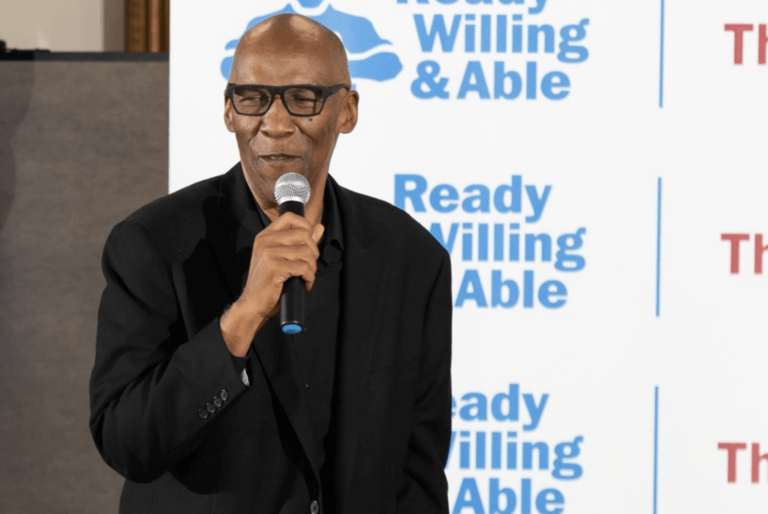
The bucket was my therapy. It taught me patience instead of intolerance. It taught me the importance of details, doing things with purpose, and most importantly what it means to be part of a team working towards one goal. My best friendships came from The Doe Fund. We shared experiences. We broke bread together. We dreamed together. The legacy of George and Harriet McDonald allowed me to turn all of my falls into lessons I can teach others. And in that spirit, I began to mentor, share, and help others.
My last position at The Doe Fund was part of the recruiting team where time and time again I saw my 47 year old self in others—just starting out with no plan for tomorrow only concerned about the next few hours—the next meal, the next gig, the next fool. Every time I recruited one into the program my heart swelled knowing that his life would never be the same, his falls will never be the same, and even the way he gets up will never be the same.
Today, I work for New York City’s Criminal Justice Agency (CJA) as a case manager and counselor to those lost in the criminal justice system in Queen’s supervised release program. I find joy in the service of others. I find peace in mentoring others through their journeys.
I am currently enrolled at John Jay College’s Forensic Psychology program and am in the seminal stages of my own mentoring company called Together We Change, aimed at mentoring at-risk adults and youth.
It took me over 25 years to get to know my place in this world. It took me a lifetime to understand that there is nothing wrong with failure, life is getting up—that’s where the WIN is in getting up and how you get up.
What separates us from the rest of the world, is that Doe Fund men know how to get up and stay up. The floor to us will never be comfortable again. We can never look onto others and not mentor, teach, preach, shoulder a pain, comfort tears, or just hold out a hand. We are Doe Fund Men and we live with purpose. And that is our legacy. Thank you.