

|
Jersey City, New Jersey
Philadelphia, Pennsylvania
Atlanta, Georgia
Chicago, Illinois
Doe Fund-led replication efforts of Ready, Willing & Able (RWA)
Jersey City, New Jersey
In 1998 The Doe Fund opened the doors of RWA Jersey City with capacity to serve 59 formerly homeless men from
Hudson County in northern New Jersey. Sparked by the interest of the Continuum of Care of Hudson County, the body
responsible for making recommendations for the use of federal housing funds from the US Department of Housing and
Urban Development (HUD), The Doe Fund was invited to Jersey City (JC) to establish its successful
Ready, Willing & Able (RWA) transitional housing and work program.
The Doe Fund worked with The Community Builders (TCB), a regional housing developer, to identify space for
long-term lease in Bergenview, a newly renovated supportive housing facility (and former YMCA) in the heart
of Jersey City. TCB was the lead developer of the project and, given the success of RWA, saw the program as
an ideal tenant. The Doe Fund secured funds from HUD through the McKinney Supportive Housing Program to house
31 RWA trainees and Section 8 vouchers pay for the balance. This Doe Fund-led effort brought
federal housing dollars to Hudson County for the first time.
Bergenview provides two floors with enough space for 59 residential RWA trainees in single
rooms, office space, program areas, and a kitchen and dining facility for the RWA culinary arts
program. Case management, intake, work & training, career development and graduate services staff were
hired to meet the local needs of the RWA trainees. At inception, as well as now, staff report
directly to Doe Fund managers in New York City (NYC). Fundraising and other administrative duties are handled by NYC
headquarters office.
As with any expansion of RWA, it was imperative for The Doe Fund to identify a sustainable
business venture to create work opportunities for RWA JC trainees. Prior to opening the
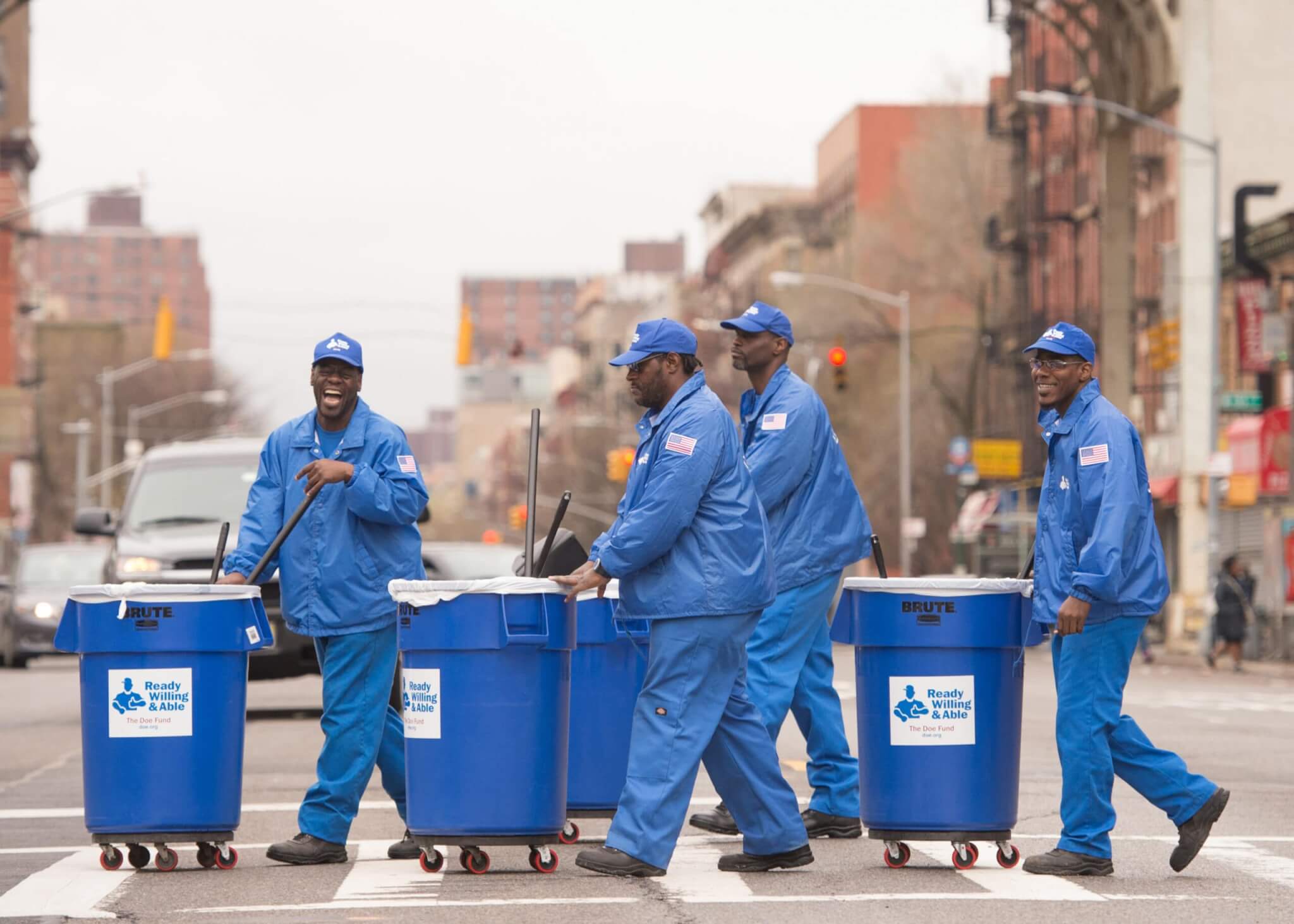
program, RWA JC obtained a contract with Jersey City Neighborhood Improvement District (JCNID) — overseen
by the City Council — to provide supplemental sanitation services identical to those provided by
The Doe Fund's Community Improvement Project in NYC. The JCNID contract covered all operating costs including
trainee stipends, supervisor salaries and uniforms. Additional work opportunities for RWA JC
trainees were cultivated through a small cleaning contract with a local business group in McGinley Square
and just over the river in Manhattan's Hudson River Park (HRPT) where The Doe Fund obtained a nearly $600,000
contract in 2001. Today the HPRT contract is nearly $900,000.
In more recent years RWA JC obtained a nearly $1 million contract with the Urban Empowerment Zone to
provide more cleaning services throughout JC. Such expansion also enabled The Doe Fund to start
RWA JC- Day to serve formerly incarcerated individuals under parole supervision. Currently, 41
individuals participate in RWA JC-Day.
RWA JC is a pure RWA model. The trainee experience is identical to that of trainees in New York City,
from intake to graduation. RWA JC provides all RWA services and opportunities including drug testing,
social services, full-time paid work, career development and graduate services. The only original program difference
in RWA JC was enhanced access to computer training, due to initial HUD funding that provided for the
development of a computer learning center for both RWA trainees and members of the community. The Doe
Fund has modeled computer training in all RWA programs off of the computer training curriculum
first developed at RWA JC.
The need for RWA in JC was clear in the beginning and demand for increased capacity to serve
homeless, as well as formerly incarcerated individuals, (in RWA Residential and RWA Day)
is at the forefront of Governor Jon Corzine's agenda. The Doe Fund is in close contact with Attorney
General Anne Miligram's office to explore further replications throughout the state.
The primary difference between The Doe Fund's operation of RWA JC and its flagship programs in NYC
is the funding structure for program operations. In the absence of significant private resources, expansion
into Jersey City was dependent on the simultaneous support of HUD (which funded housing) and the Jersey City NID (which
funded the paid work component of RWA JC).
The Doe Fund continues to explore new foundation, corporate, and individual support in Jersey City.
Philadelphia, Pennsylvania
The Philadelphia Committee to End Homelessness chaired by Phyllis Ryan made contact with The Doe Fund in 1998.
Through a report sponsored by The Philadelphia Foundation, The Committee convinced Mayor John Street and his
Administration that Philadelphia was in need of a holistic transitional housing and work program such as RWA,
and, importantly, that the city should provide start-up and operating funds for the program. In addition, Ms.
Ryan was diligent in her efforts to convince The Doe Fund to replicate two states away. Successful on both
fronts, in 2001, Ready, Willing & Able Philadelphia
opened its doors to 70 formerly homeless men from the community.
The RWA Philadelphia facility is located on Bainbridge Street in South Philadelphia two
blocks south of Center City. It houses 70 trainees and all program operations (including paid work,
housing, support services, drug testing, education, vocational training, career development and graduate
services) are identical to those of RWA NYC. 1211 Bainbridge is exclusively occupied by the program.
The City of Philadelphia Office of Supportive Housing (OSH) (formerly OESS) chaired by Rob Hess, who
would later be tapped by Mayor Michael Bloomberg to run the New York City Department of Homeless Services,
funded 100% of the initial development and operating costs of RWA Philadelphia. OSH funds cover housing,
social services, drug testing and food costs of operating RWA Philadelphia. As part of the negotiated
contract between The Doe Fund and OSH, after the first year of operation funds decreased to 90% of the
original budget, then to 80% of the original operating budget for the third and subsequent years where it stands today.
In addition, to meet The Doe Fund's requirement that there be meaningful work for trainees, OSH also
funded an initial work contract for RWA Philadelphia to provide landscaping services in Fairmount Park as
well as to provide cleaning services in two other city-operated shelters.
Due to municipal and union requirements in Philadelphia, The Doe Fund was not fully able to launch its signature
Community Improvement Project (CIP). As a result, the work contracts with Fairmount Park
and the shelters were imperative for the launch of the program and allowed experienced Doe Fund staff
to adapt the CIP model to perform similar work functions. At the same time, it was important
for The Doe Fund to explore other sustainable work and training opportunities that would generate enough
revenue to cover the budget gaps when OSH funding was reduced after the first contract year.
This effort proved successful when, in the Spring of 2003, RWA Philadelphia became the prime contractor
for vacant lot clean-up and landscaping activities sponsored by the Pennsylvania Horticultural Society. In addition,
in 2004, RWA Philadelphia contracted with the American Street Empowerment Zone which used community
development funds to provide street cleaning services to areas in need of revitalization.
Currently, RWA Philadelphia generates nearly $300,000 a year in earned revenue. The services of
RWA Philadelphia work crews are regularly pursued by businesses, government and community associations.
Though The Doe Fund initially employed New York staff for start-up purposes in order to replicate the
RWA culture in Philadelphia, the organization quickly began phasing in local professionals and
program graduates at all levels. (Today, only 7 of the 30 staff members are not graduates of RWA). In
addition, due to the distance between Philadelphia and NYC, as well as the need to more formally become
part of the Philadelphia community, in 2003 The Doe Fund made a strategic decision to hire a community
affairs coordinator for RWA Philadelphia. This position serves as an in-house expert on local
policy, government affairs, and neighborhood issues as well as a liaison for RWA Philadelphia and
the rest of the community. In addition, to pursue work contracts outside of the ones sponsored by the city
and to raise awareness with private donors, RWA Philadelphia needed to have a staff member
dedicated to networking in the city.
Several years later, not only is RWA Philadelphia no longer viewed as a NYC-run program,
it is a pillar of the support network for both homeless and formerly incarcerated individuals in the
city and serves as a resource for Mayor Nutter as he pursues innovative programming around housing and
work. In addition, public awareness and donor cultivation strategies are in place to compensate for
the fact that the work performed by trainees is less visible to affluent individuals
than the Community Improvement Project in NYC.
RWA Philadelphia had a graduation rate of 71% in 2007 reflecting the resounding success of the program replication.
Two cities that have adapted the Ready, Willing & Able (RWA) program to meet their needs.
Atlanta, Georgia
In 2002 Mayor Shirley Franklin challenged the city of Atlanta to solve homelessness. In conjunction
with the United Way of Atlanta she formed
the Regional Commission on Homelessness to
develop a blueprint to end, not manage, long term homelessness. In 2003, as a preliminary step, the
Commission performed a national survey of effective strategies and programs.
The Doe Fund's Ready, Willing & Able program was one of the programs the Commission selected as a
model for a employment-based services for the homeless. In 2004, Mayor Franklin — together with
Horace Sibley, retired attorney and Chair of the Commission, as well as other Commission members — visited
RWA and instantly appreciated the importance of RWA's holistic approach of combining transitional
housing, paid work, and support services.
Supplemental street sanitation work opportunities for the homeless were not new to Atlanta. Since prior
to the Summer Olympics of 1996, Councilwoman Mary Norwood had supported a day-labor street cleaning operation
for the homeless called SUPERB. While SUPERB met a municipal need, the day-labor model did not provide adequate
long-term training or supportive services to successfully transition its homeless participants to independence.
However, SUPERB provided a platform for Mayor Franklin to bring RWA to Atlanta.
In late 2004, the city of Atlanta partnered with Georgia Department of Transportation (GDOT), at the urging of
the Commission, and issued a request for proposals to launch a transitional employment and training
program to clean the streets of Atlanta. A key requirement for the contractor was to provide supportive
services, such as case management, job development, and links to stable housing.
Samaritan House, a well-established employment readiness
and life stabilization program for homeless men and women, was selected in the spring of 2005 to bring RWA
to Atlanta. With a $300,000 contract from GDOT, Samaritan House formed a separate entity called
"Samaritan House Clean Street Team" to operate and manage the work contract. Samaritan House then
created a coalition of partners to provide the additional components of RWA — housing,
drug testing, and supportive services. Samaritan House formed memoranda of understanding with four non profit
housing providers who have allocated shelter beds designated for Clean Street Team participants. Case management,
employment-specific soft skills training, and placement are provided by Samaritan House. Drug testing is a shared
responsibility between Samaritan House and the housing partners.
The Clean Street Team
work efforts were launched in June of 2005 with a team of 30 participants. Team members are paid a stipend of
$7 to $10 per hour based on seniority. Participants become eligible after completing 30 days of orientation
with Samaritan House. Transitional work lasts for up to 12 months. 80% of participants find mainstream jobs.
After obtaining employment Clean Street Team graduates participate in aftercare services provided by Samaritan House.
The Clean Street Team's 2008 annual budget is $800,000 including expenses for supportive services, uniforms,
transportation, training as well as stipends and excludes housing costs.
In 2008, due to a large budget deficit in the city of Atlanta, the $300,000 contract for the Clean Street
Team was suspended. Fortunately, under the leadership of Sherrie Snipes-Williams, Executive Director of both
Samaritan House and Clean Street Team, business development staff has begun obtaining other work contracts
with the Atlanta Housing Authority, Keep East Point Beautiful, the city of Decatur, special projects with
the Georgia Marathon, and Atlanta Recycles. However, Clean Street Team has been downsized to 12 to 15
members. Efforts to obtain additional work contracts and explore new business ideas in recycling have
become first priority. The future of Clean Street Team remains bright due to enormous appreciation from
the communities it serves and support from Mayor Franklin's Administration as well as the Regional
Commission on Homelessness.
Chicago, Illinois
In November of 2004 Mark Carroll, a Managing Director of Goldman Sachs participating in his company's
Public Service Fellowship, joined The Cara Program
— a community-based employment readiness program with whom he would spend one year. Eric
Weinheimer, Executive Director of the Cara Program, had always wanted to start a social enterprise
and this seemed like the time to seize the moment.
In January of 2005, the Cara team visited The Doe Fund's RWA facility in Harlem. Mr.
Carroll knew about RWA from living in NYC and was familiar with its social purpose venture
model combining employment training with a competitively run business. After spending a day with RWA
staff and trainees observing work crews and in-house operations, RWA seemed like the perfect
model for Cara to replicate. Participants in Cara's existing programs could benefit from transitional
employment, and the city of Chicago was in need of a well-run, business-oriented supplemental sanitation
service. The Cara team immediately began an aggressive campaign to
launch "Cleanslate" and cancelled plans to
visit other social enterprises.
In Chicago, Mr. Carroll and Mr. Weinheimer met with officials in the Daley Administration to describe
their plans for Cleanslate. Cleanslate would be modeled after The Doe Fund's Community Improvement Project
and would provide supplemental sanitation services in Chicago. While very open to and appreciative of the concept, the
Administration did not have resources to support the launch of Cleanslate. However, Mayor Daley's staff was able
to suggest a strategy that differed somewhat from The Doe Fund's original launch of CIP on the
affluent Upper East Side of Manhattan. Rather than cleaning in Chicago's highly visible, affluent areas,
Daley's staff encouraged Cleanslate to operate in neighborhoods in need of revitalization. Cara quickly
raised $200,000 from private foundations and donors who already supported their organization.
In the summer of 2005, less than half a year after visiting RWA, Cleanslate launched with
a crew of 10 interns cleaning in the Auburn Gresham section of Chicago. The response was tremendous
from the community. Individuals, merchants, police officers, sanitation workers, and visitors were thrilled
by not only the quality of the Cleanslate service, but the caliber of the interns who were instructed to
greet at least 100 people and 5 businesses each day and who quickly became ambassadors of their cleaning routes.
Using the privately raised seed funding of $200,000, Cleanslate committed to six months in Auburn Greham
and began outreaching in other communities for funds to launch in those areas immediately. Similar to NYC,
Chicago has business districts that form entities to sponsor additional services, such as cleaning and security,
in specific areas called Special Service Areas (SSA). Cara partnered informally with the Chicago Department of
Sanitation to identify such areas in order to bid on the service contracts.
As of 2008, Cleanslate cleans in 10 communities, 7 of which are SSAs, and generates $1.3 million in revenue
to support full-time work for more than fifty interns.
The Cara Program's replication of RWA directly emulates the business model of The Doe
Fund's Community Improvement Project. Cara offers work in Cleanslate to individuals seeking
employment services but have at least one significant barrier to employment — such as a criminal
background or low-level of education. Paid transitional employment (at $7.50 per hour with taxes deducted)
offers these individuals a chance to build a resume, gain a reference, and begin earning a wage. In order
to reduce administrative duties and expenses, Cara has partnered with a group call Employ America that handles
the logistics of payroll.
Before launching Cleanslate, Cara already had well-established case management, drug testing, job placement,
and aftercare services. Therefore, Cara did not have to initiate any of these elements to replicate the RWA
work and social service models. Cleanslate interns enjoy all of the same supports as other Cara participants.
While some Cara participants live in local shelters or transitional housing programs there is no formal
housing component to Cara or Cleanslate.
After 4-5 months working in Cleanslate, interns find mainstream employment with an average wage of over
$10 per hour. Of the 106 people who have found employment in the first 4 months of 2008, 42 are former
Cleanslate interns. Cara did not change its recruitment or intake procedures for Cleanslate even though
many more people know of the Cara Program with Cleanslate teams working on the streets.
From the initial visit to RWA where they witnessed the business savvy approach of The Doe Fund,
the Cara team made a strategic decision to market Cleanslate as a high-end supplemental sanitation service
rather than a work training program. This approach, which is credited as their key to success, has allowed
Cara to price Cleanslate services appropriately and has put them in a position to be selective about which
contracts to pursue. As the desire to serve more individuals flourishes, Cara is considering other social
ventures as well as higher margin opportunities for its existing work crews. Currently, the $1.3 million
of revenue generated by work contracts is 22% of the Cara budget. The goal is to increase this to 30% by 2010.
|