

|
By Carol Tannenhauser
Doe Fund Founder and President George McDonald first began to develop the
idea for Ready, Willing & Able more than fifteen years ago, when New
York City's homeless crisis was starting to peak. George, then a private
sector executive, found himself unable to ignore the dramatic proliferation
of homeless people in the city. His utter unwillingness to turn a blind eye to
the problem was fueled largely, he believes, by his upbringing in the
Catholic Church and education in Catholic schools. The nuns had taught him
"that other people's miseries are your miseries," and that those with gifts
and advantages have an obligation to help those without. He volunteered
for 700 consecutive nights distributing sandwiches to homeless people in and
around Grand Central Terminal, hearing their stories and gaining their trust.
Having gained political experience by running the New York City volunteer
office for Ted Kennedy's presidential campaign, George decided to run for
Congress on a platform of ending homelessness. A testament to growing public
concern about homelessness and his keen political sense, he achieved 40 percent
of the popular vote in the democratic primary and the endorsement of three major
New York City newspapers, all with a campaign fund of only $7,000. So immersed
did he eventually become in the plight of the homeless that he decided to
leave his lucrative career and devote himself full-time to drawing public
attention to the homeless problem. He raised his voice at government hearings
and press conferences. He brought reporters to Grand Central to meet his homeless
acquaintances and continually pressed them to cover the issue. He raised money
to provide direct cash assistance to homeless individuals he had come to know
for medicine, clothing, a room for a night, and other emergency needs.
George set out to prove that a formerly homeless person could create a viable
existence if he were able to obtain even a minimum wage low skill job, rent
an affordable room and stay off drugs. He already saw the fallacy that minimum
wage work was a "dead end." He believed that a job, any job, builds dignity and
confidence and leads to better opportunities. He began to live his life as a
kind of social experiment by getting a job as a law firm mailroom clerk at
minimum wage and renting a room in a single room occupancy (SRO) building.
George also fought to stop the conversion of SRO buildings to luxury housing,
aware that 100,000 of these units had already been lost. SROs had historically
served as "first rung" housing for low-income people. He succeeded in having one
such building turned over to a non-profit for use as permanent housing for
homeless and low-income adults. Later, as President of The Doe Fund, he would
personally oversee the development of a supportive SRO for homeless persons
with AIDS and the first newly constructed SRO in New York City specifically for
formerly homeless working adults.
In 1985 a homeless woman George had known and fed in Grand Central froze to
death on Christmas Eve after being forcibly ejected from the terminal. George
and her fellow homeless inhabitants of the terminal had known her only as "Mama."
The tragic event prompted George to form and incorporate an organization that
would, through innovative and holistic programs, "empower homeless men and
women to achieve lives of self-sufficiency." It would be named The Doe Fund in
honor of Mama and the countless other anonymous homeless people who live and
die on the streets of our city needlessly every year. He fashioned the new
organization based on the lessons he had learned from his many years of direct
personal contact with the homeless. During his time in Grand Central, he would
hand homeless men and women a sandwich and over and over again they would tell
him that, while they appreciated the sandwich, what they really wanted was their
own room and a job to pay for it. From this, The Doe Fund derived its guiding
principle: that the homeless are motivated to work, and they must be given the
support and opportunity to do so if they are to rebuild their lives and become
self-sufficient.
A California screenwriter, Harriet Karr had taken personal interest in a young
drug-addicted homeless woman named April while doing research for a film and
had made many trips to New York City to try to rescue her from the streets.
George had also known and tried many times to save April. The two met at
April's funeral after her suicide at age 19. Six months later they were
married and channeled their shared commitment into addressing the homeless
problem by building The Doe Fund. Harriet brought her writing skills, compassion,
poise and, despite her vastly different background, a remarkable ability to
relate to the homeless and their problems. Together, George and Harriet developed
and set out to implement Ready, Willing & Able, the first residential
paid work and training program for homeless people.
They had secured from the City's Department of Housing Preservation and
Development (HPD) both the funding to purchase and renovate an abandoned
building on Gates Avenue in the Bedford-Stuyvesant section of Brooklyn, and a
work contract to hire and train people to renovate city-owned apartments for
occupancy by homeless families. Their idea was to forge a workforce from single
homeless men and to house them at Gates Avenue. George and Harriet went to the
streets, to Grand Central, and to every men's shelter in the city to recruit
participants. "If you're willing to stop using drugs and go to work everyday,"
they said, "come to the Church of St. Agnes next Saturday morning." Hundreds of
homeless men showed up to take advantage of this rare opportunity. The first 45
"trainees" began working for The Doe Fund on January 2, 1990. The question now
was: could they and would they do the job?
The odds were against them. Averaging 32 years of age, most of the men had
never held a job outside the drug trade in their lives. They were short on
education and long on legal problems, debts, and criminal records. They had
incredibly convoluted relationships and psyches scarred and stunted by lifetimes
of neglect and abuse. They were raised in blighted neighborhoods and in families
without fathers, resources, opportunities, stability or dreams. Worst of all,
they had vicious drug addictions. Many could not remember a time when they were
not getting high. And yet, from day one, the men outperformed the expectations
of the city contract. Ready, Willing & Able worked.
The program mirrored what society would ultimately expect of those who
graduated. Trainees relinquished welfare benefits in favor of $5.50 per hour
in wages, paid $65 per week toward their room and board, and put $30 per week
in savings accounts. In return, they slept in comfortable beds in semi-private
rooms, and ate healthy, hearty meals prepared by trainees who expressed interest
in food preparation as a possible career. As the program developed, there were
caseworkers on staff, nightly 12-step meetings, life skills classes, and
certified teachers to help those who needed them earn high school equivalency
diplomas or, in some cases, to learn to read and write. What George McDonald
had known all along proved powerfully true: "Work works." By 1994, 90 formerly
homeless and drug-addicted men had entered the legitimate workforce. They were
staying clean, doing their jobs diligently and well, paying rent, saving money,
repairing old relationships and forging new ones and looking to the future.
The success of the program highlighted everything that had gone awry in the
City's sprawling, drug-ridden public shelter system and disproved the perspective,
frequently trumpeted by housing advocates, that homelessness is solely an issue
of a housing shortage. In 1991, Mayor David N. Dinkins invited George to
participate in a Commission on Homelessness headed by future Housing and Urban
Development (HUD) Secretary Andrew Cuomo. Together the members of the Commission
created The Way Home, a model for addressing homelessness that has since served
as a blueprint for homeless policy both locally and nationally. The Way Home
pointed to the multiple and interrelated underlying causes of homelessness --
the severe and persistent barriers to employment faced by the homeless and the
pervasiveness of substance abuse among the population. It called for a holistic
approach that would systematically address these barriers to reduce homelessness
permanently. Ready, Willing & Able was the model for and embodiment of this
theory later called the "continuum of care."
Despite its very well publicized success, the program has faced several
challenges. The Doe Fund's ability to respond creatively and with flexibility
has been the key to its survival. In 1995, the City changed its mayor and its
philosophy about city-owned, low-income housing; The Doe Fund's work contract
was slashed by more than 60 percent. There was not enough money to pay the
trainees or the staff salaries. The McDonalds were faced with the possibility of
returning the men who had worked so hard to rebuild their lives to the streets.
Unwilling to even consider it, George came up with a plan.
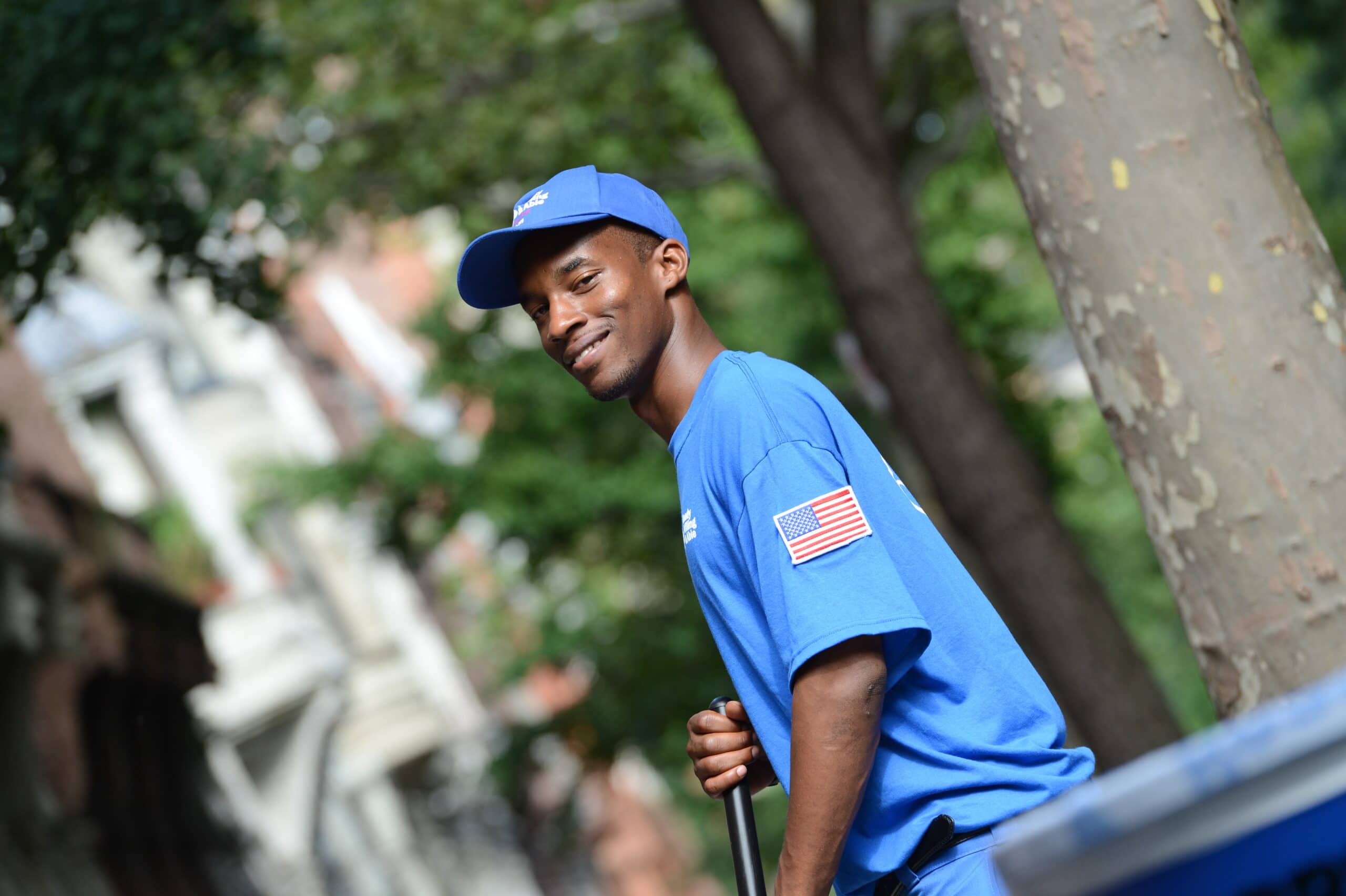
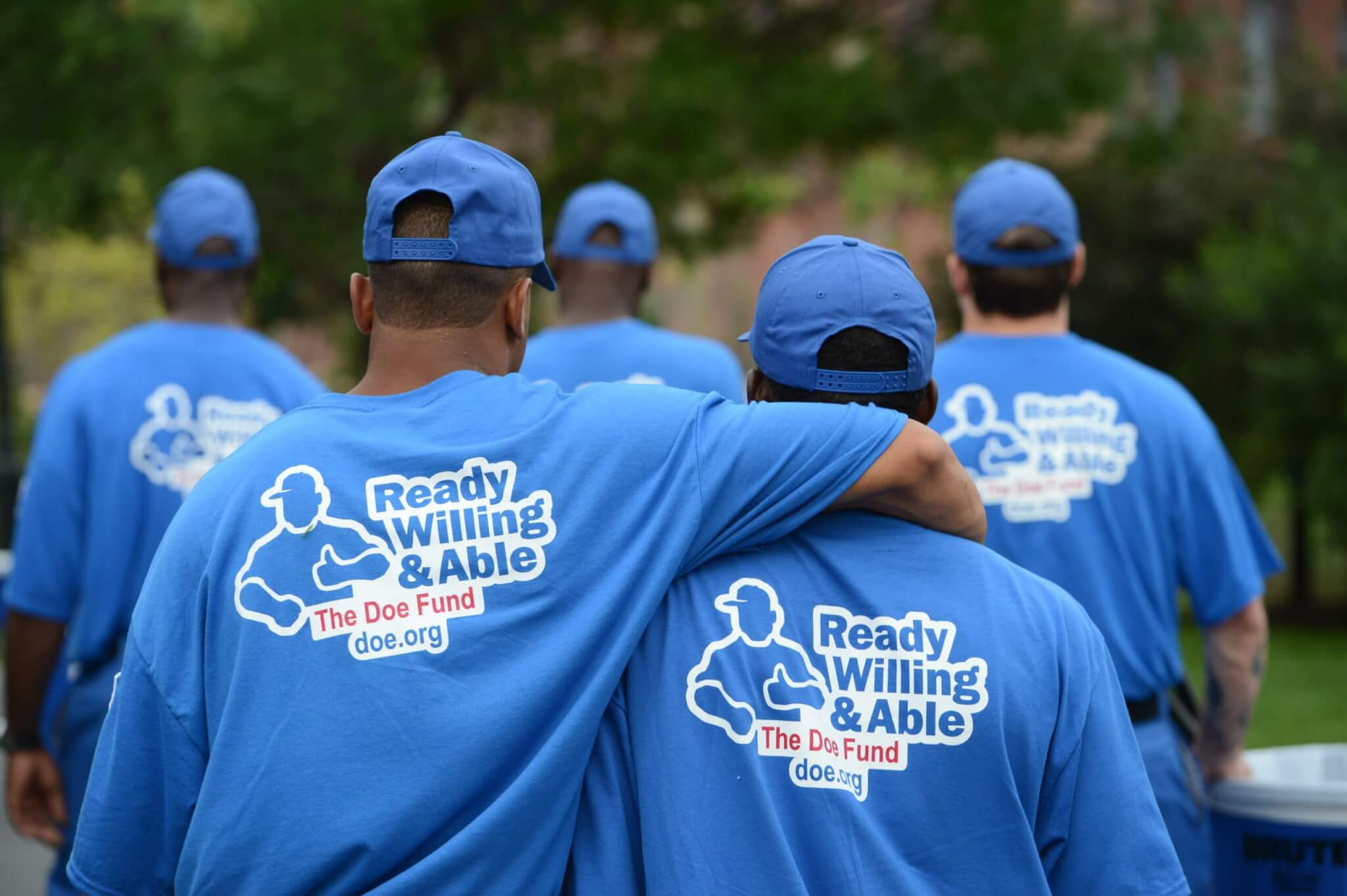
He and Harriet live on East 84th Street, not far from East 86th, which used
to be one of the filthiest stretches on the Upper East Side. "This is what we're
going to do," he said. "We're going to take the money we have left and we're going
to buy really nice uniforms and we're going to put the guys on 86th Street and
they're going to clean it up every day and the community is going to want to
support us." And that's exactly what happened. At a time when most had developed
"compassion fatigue" regarding the homeless, The Doe Fund was able to tap into
both the industriousness and potential of its formerly homeless trainees, as
well as the concern and generosity of the City's business community and private
citizens.
|